Wednesday, 16 November 2011

A Question of Cricket

I’ve got back into “A Question of Sport” recently. For any readers outside of the UK who at this point are saying “WTF”, QofS is basically a sporting quiz on the BBC that features famous sportsmen and women past and present. It’s a little bit kooky and with Phil Tufnell on the panel it can even border on "zany" occasionally. 
 
On Monday night, Jonathan Trott was a guest on the show. The guy is a fricken genius. He knew the answers to every sport: rugby, motor racing, football the lot.

It reminded me that he and his England colleagues are finally on a little break from playing cricket, as he cosied up to Matt Dawson et al. He’s been playing cricket solidly for months and months. A rest and an appearance on QofS is just what the doctor ordered.
 
A little rest and relaxation can do wonders for professional sportsmen, just ask Carlos Tevez.
 
Not all cricketers are chillaxing right now though, with Australia currently touring South Africa and India playing host to the West Indies. Sri Lanka are also concluding their series against Pakistan with a round of One Day Internationals.

The crowds for all these series have been disappointing though, and in the case of the India vs West Indies series they've been atrocious. Less than 1000 people turned up for the opening day of the second test at cricketing institution Eden Gardens, even with the chance of Sachin Tendulkar scoring his hundredth test hundred in the offing.

But can you blame the good people of Kolkata? It's only a couple of weeks since England played India in back-to-back One Day and T20 international matches there.

Sure, when your national cricket team rock into town it's a big deal, particularly when it's your national sport as cricket is in India, but buying 3 lots of tickets for international matches within a couple of weeks of each other is going to stretch anyones purse strings.

Not only that, but the first day of the second test match was on a Monday. Now call me an old stick-in-the-mud but people do need to work occasionally, especially if they are paying exorbitant prices for, amongst other things, going to cricket matches.

Its clear that international cricket is being scheduled around TV stations nowadays, so we shouldn't be surprised. Despite the miles between India and South Africa, their games have seemingly been scheduled so that they don't overlap each other, meaning global TV audiences can enjoy both matches without missing a moment (if of course you are that keen to watch both series that is!) 

The speed at which wickets have fallen in both series thus far though, notwithstanding India's gargantuan 631/7 declared in the second test at Eden Gardens means the schedulers need not have worried so, but that's another issue. 

The point is, with the emphasis so obviously on TV schedules and not on the paying public actually going to the ground, is there any wonder Eden Gardens looked like a "morgue" on Monday, as Tony Greig put it?

And it was. And it was horrible to see. But the ICC and the cricket boards (and the TV companies) that schedule these tours only have themselves to blame.

We all love seeing cricket, but let's keep it sacred. Saturating the market never did anyone any favours. 

A lot of people watch cricket on TV and I don't have a problem with that. It's a global sport, and the TV companies do a great job in allowing us all to watch cricket wherever it is taking place in the world.

But seeing the empty stands at Eden Gardens yesterday and to a lesser extent Newlands in Cape Town last week, which wasn't full either - amazing for such a high-profile series, is going to have a negative impact on the game in the long run.
 
A Question of Sport is, in truth, a little bit dull, but it's good to have a little rest-bite from the things we love. Less cricket might, for the players as well as the paying public might just do us all a favour.
 

Thursday, 10 November 2011

Imran Tahir and the Best Test Debut Ever!

Cleaned Up! Tahir on test Debut
The test match going on at Newlands, Cape Town at the moment will be remembered for many things, but being Imran Tahir's test debut for South Africa is unlikely to be one of them, unless South Africa lose 8 more wickets on day 3 and the former Hampshire spinner is required to score the winning runs.

Unlikely, but hell, crazier shit has happened today!

Australia resumed on day two with captain Michael Clarke a ton to the good and his side in a position to pass 250, the minimum Clarke had deemed as acceptable at stumps on day one.

Clarke took Australia to 285 all out and seemingly "in the match".

Tahir bowled a handful of tidy enough overs but it was other debutant, Vernon Philander who took the plaudits taking three wickets whilst Dale Steyn's ferocious fast bowling had the hyperbole-merchants going into overdrive with his figures of 4/55.

What came next was borderline farce. First South Africa capitulated for 96 all out before Australia went one "better", in the lunacy stakes, by scoring a hundred-year worst of 47 all out, yes, ALL OUT, in their second innings.

18 wickets fell for just 68 runs in the afternoon session in what was a quite unbelievable day of test cricket.

And it was needed, even if you're an Australia fan. After the negative headlines of the spot fixing trial and the poor attendances of last weeks India vs West Indies test match in Dehli, this scintillating battle has resonated all around the world, confirming what many of us have known for a long time - that at its best, nothing beats test cricket.

South Africa put on 81/1 in their second innings before stumps at the end of day two, needing 155 to win with 9 wickets still in hand and they'll fancy their chances. It is quite unbelievable that, going into day 3, we are already talking about a 4th innings chase - it's been a surreal, incredible game of test cricket.

But what of our man Tahir? Well, he might not have much more to do in this game, sadly for him. A dozen or so inoffensive overs, no wickets and two runs with the bat, but I think he might just remember his first game in test cricket rather fondly, if the Proteas seal the deal tomorrow.

Thursday, 3 November 2011

Cheats Never Prosper....Hopefully!

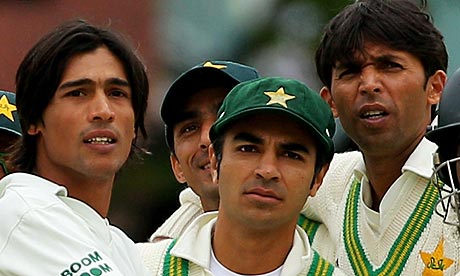
Mother always told me "cheats never prosper", and yesterday in Southwark Crown Court, Salman Butt and Mohammed Asif learnt that lesson the hard way.

Guilty of cheating and accepting corrupt payments the two, along with young Mohammed Amir, who pleaded guilty to the same charges before this trail started, have reminded us all of the perils of corruption in professional sport.
 
Perhaps the most worrying aspect of the whole case was how orchestrated and widespread this particular fixing racket allegedly was, with Mazhar Majeed, the 3 players agent, supposedly the ring-leader, taking requests to fix aspects of test matches that Pakistan played against Australia and England during the summer of 2010, from clients all over the world.
 
Requests that were placed as casually as social plans are made between friends, Majeed seemingly had control of half the Pakistani team, with Kamran Akmal and Waheb Riaz also implicated by evidence deemed inadmissible for this trial.
 
This trial centred on the bowling of three no balls, but this could potentially be a small drop in a rather large and murky ocean, if the other evidence now in circulation is to be believed.
 
Former England captain Michael Vaughan has spoken since the verdicts were handed down of his concern around suspicious events that occurred whilst he was still playing. This trial has resulted in 3 convictions, but there are almost certainly more skeletons in the cupboard.
 
Nick Hoult, cricket writer for the Telegraph newspaper and present in court throughout the trial has since written about evidence, text messages, from and to Majeed, talking about fixing set periods of play ("brackets") during test matches last summer. It is alleged that the requests from clients would go on to determine who would bowl for Pakistan and when, and how many runs they would concede off their own bowling.
 
If this was not delivered to order, Majeed would get complaints from angry punters – the game merely a vehicle to facilitate a book of illegal orders, the ebb and flow of test match cricket reduced to inconsequential farce.
 
How, if these additional allegations are true, could then Pakistan captain Butt focus on setting fields and building pressure on batsmen to take wickets whilst at the same time remembering how many runs were required from specific overs in a bracket to facilitate his agents orders? 
 
This is a major moment for the future of all forms of cricket. Illegal betting isn’t just restricted to test matches, T20 cricket has spot betting too, and given the size of the enterprise that is the IPL for example, we would be foolish to believe other forms of cricket are immune to corruption. 

The ICC need to make a stand on this immediately. The News Of The World brought evidence of this practice out of the shadows and onto crickets main agenda, and the authorities in the UK have built a case, the effect of which will reverberate around the cricketing world, but now the ICC has to continue to investigate suspicious patterns in betting and on-field activities, and hand down the most severe penalties to anyone found guilty.
 
But players need to take responsibility too. Salman Butt has earned £1.7mm from playing cricket over the past few years. It’s not a bad wage, one that he surely could have survived on without plunging into the depths of an illegal spot-fixing syndicate.
 
I read this morning how Mohammed Amir had terrorised the England batting lineup last summer, taking 19 wickets from 4 test matches played. He was a revelation and was made Pakistan's man of the series for his efforts. 

The waste of talent in his case in particular is extraordinary, and perhaps the best we can hope for is that he returns to cricket one day a reformed character, realising his potential as an exceptional bowler whilst at the same time educating young cricketers against the dangers of getting involved in the illegal spot-fixing under-world.

It may take a role model like Amir to fully deter young players from ever doing something as greedy and foolish as this in the future.

Friday, 28 October 2011

Blackouts, Whitewashes and Red Faces, England’s One Day Tour of India

Perhaps it was an omen? As the five-match One Day International series between India and England kicked off at Hyderabad on October 14th, Sky Sports were forbidden from broadcasting the game by the BCCI. Normal service was thankfully resumed shortly thereafter, much to the relief of the England fans watching back at home.

At that stage of course optimism was still rife that England could compete in the series, making up for a wretched record in India of only 1 win from their previous 13 matches. Hell, some of us even thought a series win was possible!

Ah the innocence of wild optimism...
 
India were 129 for 4 batting first at Hyderabad and at one stage England felt they were in with a chance. But then Mahendra Dhoni came in and scored 87 runs off 70 balls including 10 fours and 1 six, all during the supposedly slower "middle overs". 
 
It’s not just that Dhoni is an incredible finisher; it’s that he can do so on any type of wicket, and at any stage of the match. He played well in England during the summer, apart from Rahul Dravid India’s best player all tour, and he’s been even better back home. 

England could do worse than try to emulate Dhoni in their search for a credible wicketkeeper-batsman rather than looking for the next Adam Gilchrist, as has been their want of late.
 
Craig Kieswetter’s wicket-keeping was erratic and inconsistent this series, taking stunners and dropping dollies in equal measure, but given the explosive nature of his batting, (seldom seen on this tour though to be fair), it is likely he will be given another chance. 
 
In truth though, all of England’s batsmen struggled. Too many starts were not converted and as a result England only batted out their allotted 50 overs once in 5 matches. That simply isn’t good enough in One Day cricket.

Eoin Morgan is England’s best limited overs batsman, particularly when it comes to scoring aggressively against spin, and his absence was sorely missed in India. All of England’s batsmen struggled to keep the runs coming when India’s spinners came on, often giving their wickets away when trying to force the issue. The likes of Ravi Bopara may struggle to come back from this series, failing again to prove that he’s quite up to this level of cricket.

England also failed to embrace spin in their bowling attack. Promising young leg-spinner Scott Borthwick was in India but his only appearance came when replacing Graeme Swann in Mumbai, the series already dead and buried, rather than being picked to bowl in tandem with Swann, which would have been a much braver and more aggressive move on sub-continent wickets.
 
You can’t pick a spinner just to make up the numbers but if England didn’t think Borthwick was ready for India, why didn’t they take Monty Panesar instead, who at least has the experience to cope with the pressure of playing in front of India’s vociferous fans. Either way, playing two competitive spinners is crucial if you are going to restrict runs and take wickets in India. 

Another man sorely missed was Stuart Broad, and perhaps if he had been in India, England would have been more inclined to bowl a second full-time spinner. His inclusion, possibly at the expense of Samit Patel, could have allowed Borthwick to play without having a detrimental effect on England's batting lineup.

Of course we have to offset the disappointment of this series with the "bigger picture" and that of course comes in the shape of the World Cup in Australia and New Zealand 2015. England will still fancy their chances there on the harder, bouncier wickets, but England’s One Day form down under wasn’t much better in January, losing 6-1 against Australia.
 
The back drop to that series of course was that England had won the Ashes earlier on that tour, and therein lies the biggest obstacle to England's success of in One Day cricket; their obsession with test cricket.

Domestic cricket in England is set up to produce successful test match players, and obviously we have seen the success of that policy over the past 12 months. 

However as a result, One Day cricket comes second. Limited overs County Cricket is still 40-overs-a-side and that immediately puts England at a disadvantage when it comes to the international scene. The middle overs that England failed to convert successfully in India are exactly the part of the game they miss out on when playing domestically. This needs to change if England are to compete in 50 overs international cricket.

Despite 2011 being an incredibly successful year for English cricket generally, this side will return home from India disappointed. 2015 is a long way off, but England will need all of that time to ensure they are competitive at the next World Cup, otherwise there could be a few more England players with red faces in 2015.

Monday, 24 October 2011

England in a Spin Over Selection in India

Desperate Decisions or Time to Experiment?

4-0. Not quite Manchester United vs Manchester City (ouch!)  but still a fair hammering for any side in any sport.

England have been out-played in every department for the duration of this One Day Series and even a shuffle of the pack for the forth One Day International in Mumbai couldn't stop the rot for the tourists.

Scott Borthwick and Stuart Meaker, two young, promising bowlers who went to India optimistic, part of a young England squad that was building for the World Cup in 2015, came in for Graeme Swann and injured Jade Dernbach in Mumbai, a dead rubber, hardly the stage they were hoping to perform on.

England's selectors have developed a reputation for being loyal to a fault to the players they put out to play each match, a policy that has reaped dividends in test cricket, but with a One Day side that didn't look right from the first ODI in Hyderabad two weeks ago, changes should have been made earlier than the match after this series was already settled.

Of course that's incredibly easy for me to say sitting on my comfy chair with my soft cushions, but England have played only one front line spinner in all four games on this tour of India, yes India, you know that country that notorious for slow, spinning wickets, and that's just madness.

Swann and Borthwick should have bowled in tandem in Mumbai, if not earlier in the series which would have given England 20 overs of spin that would have taken the pace off the ball and made scoring harder to come by for India. 

Instead, with three seamers trying their best to extract some life out of the dry, dead Indian wickets, the part time spin of Samit Patel and the medium pace dibby-dobbers of Ravi Bopara, the solitary spinners   just haven't had enough support to build pressure on India, and the home side cruised past England's totals in each of the four innings played.

Clearly the batting has struggled to post enough runs too, and whilst there has been ridiculous criticism of Jonathan Trott, again on this tour, questions still remain above the heads of both Craig Kieswetter and Ravi Bopara.

Eoin Morgan has been missed and presumably he will come in for Bopara when he returns from injury, and it may be that Kieswetter drops out of the team, again, this time for Ian Bell to return?

I'm not sure if it's mildly embarrassing or even insulting for Bell that he has not been given the chance to play in this tour, or perhaps the selectors know only too well what Bell can do and therefore don't feel the need to test him out in India, but why take him if he wasn't in the selectors thoughts?

But none of the batsmen have excelled in India, and that includes captain Alastair Cook. In fact, Cooks form is perhaps the most worrying of all the top 6. It hardly fills a team with confidence if their skipper is putting the side into bat (as Cook has done all tour) and then falling cheaply, as Cook has also done all too often.

Cooks appointment as captain was always a curious one given the fact he hadn't played any One Day International cricket for several years before hand. In fact, he wasn't even in the One Day squad for the World Cup earlier this year, also in India. 

Cook is still new in the role, and deserves time to build his team now he had been appointed, but whether he was the best candidate for One Day captain, rather than simply the next in line for the test side, is another question.

Oddly, worryingly, sadly, England will return home from India with more questions about their One Day policy than they had when they headed out to the sub-continent just a few weeks ago.

The selectors have been loyal for a long time, but perhaps their decision to back the side when it wasn't set up correctly to begin with was a mistake on this occasion? Sometimes no change is good, other times you need to cut your losses, be strong and make positive changes. That hasn't happened in India.

It will be interesting to see what England's One Day side looks like when they play Pakistan in the UAE early in 2012, but I expect some changes from the side that has lost so meekly in India. 

Friday, 21 October 2011

Jonathan Up The Creek? Trott On!!

If people think that taking Jonathan Trott out of England's One Day International side will result in a transformation of England's fortunes in this form of the game, they've clearly not been watching much One Day cricket lately.

Trott scored 98 of England's 298 runs at Mohali in the 3rd of this 5 match One Day International series against India, yet all I've read about since the match is that his place is in jeopardy!

Never mind the fact Alastair Cook fell cheaply again. Never mind "The Next Gilchrist", Craig Kieswetter can't get past 30 and keeps dropping sitters. Never mind England are playing 3 seamers on slow, flat wickets and only one front-line spinner. Yup, if Trott was dropped, things would be alright!

For me, Trott is the key man in this One Day side along with Eoin Morgan, who is sorely missed in India by the way.

Morgan can win a game from nowhere, killing opponents in seemingly dominant positions, and you cannot underestimate the loss of a player like that on this tour. India have Dhoni, an equally capable "finisher", and he has won 2 of the 3 games in this series for India almost single-handedly.

Morgan can attack even when facing spin from both ends, a pre-requisite for excelling on the sub-continent and something all England's other players struggle to do, even Trott. 

But, Trott is so hard to get out. Even Morgan goes cheaply sometimes and in those situations, it's essential Trott is there, otherwise England's innings can and usually do fall apart.

If Trott is in, the players at the other end can go for their shots. Pietersen and Patel both filled their boots yesterday, and 298 is actually a decent total. The fact England didn't defend it isn't attributable to Trott in my opinion.

England's fielding has been abject in this series, a surprise given recent high standards, but at the risk of sounding like a broken record, you're never going to excel in India playing 3 seamers and only 1 decent spinner. 

I know it extends the tail, but I honestly think Scott Borthwick needs to play in the last 2 games. England are desperate for more spin options, so why not give Borthwick a go, he has already played international cricket and done well, albeit at T20 level.

I like Ravi Bopara but there is an ongoing debate as to whether he has the stomach for cricket at this level and with a change in fortunes required, perhaps Rav is the man to step aside? his part time medium pacers don't seem to be fancied by Cook and he just isn't delivering runs on this tour.

Kieswetter is also a question mark. He looks good in home conditions, but a delicate touch is required on the sub-continent, and I'm not sure Kieswetter possesses one. Ian Bell has to return to the side now, he is too good a player to sit on the margins and, incredibly, bring the drinks out, as he did in the last game. He could replace Kieswetter and Bairstow could keep wicket.

Finally, let's play a fast bowler who is suited to these conditions. Stuart Meaker is a skiddy bowler who should be able to serve up plenty of yorkers at the death, something amazingly England's current attack seem incapable of doing, so give him a chance too.

There's plenty of changes that could and perhaps should be made to this England side to make them more competitive, certainly on the sub-continent anyway, but Trott isn't one of them.

They're up the Creek, but Jonathan Trott must stay.

Wednesday, 19 October 2011

Payback Time For England: ODI Series Update

Indian fans and pundits alike were hurt by their teams’ capitulation in England this summer to the extent they named the return series that began in India last Friday as the "Payback Series".
 
And if teaching England a ruddy good lesson in One Day cricket was India's primary objective for this tour and let's be honest, it was a little bit, then India have succeeded, with devastating effect.
 
India have won the first two One Day Internationals of the tour by a mile and have been better than England in every facet of the game. The likes of Dhoni, Gambhir and Kohli have scored big runs, Umesh Yadav and Vinay Kumar look dangerous with the ball, a far cry from the impotent attack that toured England this summer, and perhaps most surprisingly India’s fielding has been razor sharp – much better than their English counterparts.
 
But for as good as India have been, and they have been very good, England have been poor and have gifted India these first two games.
 
Alastair Cook believes his sides problems are partly psychological, and certainly with only 1 win from their last 15 One Day Internationals in India, England may have a mental hurdle to overcome, but more worrying for Cooks’ side is that the balance of the team doesn't look right and their tactics seem to be just scratched in the sand, changing from game to game.
 
England have lost wickets regularly in both innings in this series so far, and that is of particular concern. One has to question why for example, after his captain was out for a duck having won the toss and choosing to bat first, Craig Kieswetter elected to prod at a wide ball that did very little, giving his wicket away without troubling the scorers himself in Delhi?
 
Surely England's batsmen know that if you lose a wicket, it's best to be disciplined and consolidate for a period, rather than carrying on and losing further wickets in quick succession?
 
England’s bowlers are not completely absolved from blame here either. Apart from Bresnan, who has been the pick of the bowlers in both games, the rest have struggled.
 
England have played 3 quick bowlers in both matches but with no pace in the pitches or movement off the seam of through the dry Indian air, 30 pretty tame overs have been sent down which, once the new balls have worn soft, give the Indian batsmen time to set themselves before using the pace of the ball to earn easy runs. As bowlers tire, so the more expansive shots become easier.
 
England should have learnt all this from the World Cup here earlier this year. During that competition, the teams that fared best took pace off the ball almost all of the way through the innings to make it harder to score runs. Its fundamental stuff on the sub-continent.
 
England have Scott Borthwick in their squad, a young and talented leg-spinner from Durham, why not give him a go? Dropping a seamer for a second spinner may not rest that easily with England, but they have to adapt to the conditions and playing three seamers in a One Day International in India into opponents hands.
 
Cook mentioned a mental block that England need to overcome to triumph in India, but perhaps the issue is more deep-rooted than that. 40 overs-a-side cricket matches are played on the county circuit in England as opposed to 50 over matches at International level and perhaps that 10 over disparity has an effect on England players, to the extent they rush and panic when batting and try and force the issue when bowling?
 
It's a theory, but by playing these One-Day-specific tours regularly going forward as the ECB plans to, England players will surely learn how to pace an innings better, when to push and when to consolidate, not to mention how to bowl to the conditions available to them; it still astounds me how few yorkers English bowlers bowl at the death when opposition attacks send down seemingly little else during the final few overs for instance.
 
There are fundamental flaws in the way England approach One Day cricket away from the comforts of home, particularly on the sub-continent, and these will take time to resolve. They might not win this series, in fact they might be on the end of a bit of a hiding from India, but if they can begin to develop a more savvy approach to One Day cricket, it won't have been a wasted trip after-all.

Monday, 10 October 2011

India vs England Series Preview - And The Point Is...?

Critics have said that the series between India and England starting in Hyderabad on Friday 14th October is little more than a money spinning extravaganza, taking advantage of Indian fans love of limited overs cricket with a meaningless procession of five One Day Internationals and a T20 during a 3 week tour that has been shoe-horned into an already hectic international schedule.

Indeed this tour isn't even an obligatory one. The ICC demands that every major cricketing nation plays each other home and away over a nine year period, something known as the Future Tours Programme and England touring India is certainly not a series in danger of defaulting on that promise any time soon.

For me though, this tour is a great idea. Never mind the financial implications; this One Day series pits current World Champions India against an England side hoping to claim their crown at the next World Cup in New Zealand and Australia in 2015.

Captain Cook with Head Coach Flower
Since winning the Ashes in January, the first time England have triumphed Down Under in 24 years, Andy Flower has put success in One Day cricket at the top of England’s agenda. However after a disappointing showing at the World Cup in April 2011, losing by 10 wickets to Sri Lanka in the quarter finals, changes were needed and Alastair Cook has since replaced Andrew Strauss as captain in this format.

With home series wins over Sri Lanka and India already secured under Cooks captaincy the future looks bright for this young side, but this tour of India will be their toughest assignment yet and we will learn a lot about just how far England have come by the end of it.

Historically England have struggled in India, winning only one of their last 13 One Day Internationals here, so any success enjoyed in this series will be a real statement of intent from Cook’s men.

But regardless of how this series progresses, it's just nice to see England and the ECB focussing their efforts on 50 over cricket, rather than annexing a One Day International series awkwardly to the end of long test schedule, as if it were a warm-down exercise to the main event.

Look at the Ashes schedule last year. Many people, including Sir Ian Botham, bemoaned the decision to play 7 ODI's at the end of such a draining and intense test series. Those One Day Internationals were supposed to be a warm-up for England’s World Cup campaign but with players tired and unmotivated, poor performances and injuries were all England took home from that series.

Whether One Day cricket is your thing or not is up to you, but one thing’s for sure: for England to prosper in this format it is imperative that they play more series like this one, focussing specifically on the 50 over game, building a specialist squad to compete with the best teams around.

This series should tell us a lot about whether England's masterplan for world domination in every form of cricket is on course, but it is unlikely to be one-way traffic. Given India’s strength at home, plus England’s appalling record there, even a narrow defeat may give rise to optimism in the camp, depending on how well the side performs.

My only concern is that in continuing the rotation policy that sees Jimmy Anderson rested for this series, will we actually see an England One Day side that is essentially the first XI regularly enough before the World Cup in 2015?

In Australia last year, Alastair Cook shined the ball for the whole of the test series. Why? Because out of all the England players, he sweated the least (sweat on the ball reduced the chances of getting the ball to reverse swing).

To be the best, that level of detail needs to be considered, and I just hope that England remember to hone a winning first XI as well as amassing a huge pool of players from which to choose from.

Or perhaps I'm just being pedantic now?

Wednesday, 21 September 2011

Danny Briggs: No Spin Required

Hype can get a little boring, but after a disappointing season for Hampshire which saw them relegated from division 1 in the LV= County Championship as well as being dethroned as T20 champions by Leicestershire, Royals fans will take anything they can get!


Hants spinner Danny Briggs, 20, is the real deal though; no hyperbole required here. In the 2011 season, Briggs became the second youngest bowler after Derek Underwood to claim 100 first class wickets in County Cricket history, and this week he has joined up with England's senior squad for the first time after his inclusion in the squad for the T20 series against the West Indies.
 
Born on 30th April 1991 on the Isle of Wight, Briggs made his debut for Hampshire's first team in 2009 at the age of just 18. Breaking into the one-day side first, he later claimed the prized scalp of Somerset's Marcus Trescothic in his County Championship debut.
 
After a successful first season for Hampshire Briggs was called up to England's Under 19 squad for the tour of Bangladesh in October 2009, before travelling to New Zealand in January 2010 for the Under 19’s World Cup. Briggs excelled on both tours, returning from Bangladesh as leading wicket taker with 8 scalps from 7 One Day Internationals and was man of the match against Afghanistan at the World Cup, claiming 3 for 11 runs en route to the quarter finals in New Zealand.
 
Now firmly on the ECB's radar Briggs returned to Hampshire for the 2010 season taking 34 wickets in all competitions and was his sides leading wicket taker in the shortest form of the game as Hampshire lifted the Friends Life T20 trophy in front of a home crowd at the Rosebowl.
 
Briggs was then named in the England Performance Squad to tour Australia at the end of 2010, shadowing the senior squad on the Ashes tour. "I want to break into the Lions squad and the EPS (England Performance Squad) will help me do that," Briggs said of his inclusion in the squad. "This trip (to Australia) is about showing the coaches what I can do and improving my game. I've had a great year for Hampshire and it gives me a lot of confidence. There are some solid cricketers out there and it will be good to pick their brains in training and see what they do to get them to such a high standard.”
 
The Performance Squad went on to win both their matches Down Under with Briggs again excelling, taking 4-9 against Queensland XI. ECB Director David Parsons praised Briggs' performances in Australia, saying "It re-enforces his reputation as a young player of clear potential.”
 
A successful spell in Australia resulted in a call up to the England Lions squad for the first time to tour the Caribbean in January 2011. The Lions took part in the West Indies Cricket Board regional 4 day championships and again Briggs impressed, taking 15 wickets in 5 matches at an average of 24.
 
James Hildreth, Lions Captain for the Caribbean tour was full of praise for Briggs, saying "Every time I put Briggsy on to bowl he seems to get wickets, and he's really good at keeping it tight. He knows his game really well. He's obviously flourished in the 20 over format, but watching him bowl in four day cricket over in Australia and now out here in the West Indies, he's been doing really well."
 
Hildreth continued "He works hard in the nets and he's one of those bowlers who has quite a simple philosophy really - he doesn't try and vary it too much. He's got subtle changes in pace and spin and that works. He gets a lot of people trapped at the crease LBW and bowled and he knows what fields he wants."


Back home, the 2011 season may not have gone to plan for Hampshire, but Briggs' form has remained constant, something that has not gone unnoticed. Briggs’ Hampshire team mate Nic Pothas is one that sees the potential in the young spinner. Speaking in his Southampton Daily Echo column recently he said; "Briggsy is very young for a spinner but is maturing very quickly. He has been outstanding for us in the Friends Provident T20. He has the X-factor that most good spinners have in being able to read what a batsman is going to do next. If Danny Briggs reminds me of anyone, it is New Zealand star Daniel Vettori."
 
"We've always said he is like a left arm version of Shaun Udal, but he is also very quiet and Vettori-like.”
 
After successful spells with England's Under 19s, EPS and Lions teams in the past 12 months, the next step for Briggs was always going to be the full England squad, however the speed at which Briggs has made that step up - he is still only 20 after all - has been quite phenomenal.
 
He has the potential to be a top spinner for England and he will only develop by training with the senior England players, guided as he will for this two match series by the best English spinner of his generation, Graeme Swann.
 
Briggs knows that he has to keep doing the simple things well to continue his remarkable ascendancy up England's ranks. "A good ball is a good ball to any player. If I can just carry on and keep it simple, the better I can be." Hampshire and England will certainly hope the man from the Isle of Wight continues to do just that.
 

Friday, 9 September 2011

No Need For Duck-Worth Lewis at the Rosebowl

Until around 18:00 on Tuesday 6th September at a sodden Rosebowl in Southampton, the highlight of my day was getting Sunil Gavaskar to hold my duck. Now this isn't some crude or inappropriate euphemism, I'd probably better explain.
 
Sunil Gavaskar - one of the more
 surreal ducks of his career

 My best friends father Mike, who is sadly no longer with us, took a cuddly duck with him to Australia for the 2006 Ashes series. Quite apt given the way the Aussies ripped through England's batting order that year.

Anyway the Duck became an icon, sharing photo opportunities with the likes of Sir Ian Botham, Mike Atherton, and Merv Hughes, and now we can add to that fine list one of India's greats. Childish I know, but Gavaskar was a great sport for humouring me at least!

Tuesday was one of those days where grown men acted like children in the face of unavoidable, unrelenting boredom. Some Indian fans led a group containing 2 father Christmases around the ground singing and banging Tabla’s, whilst others played hand cricket with vaguely round objects.

At 16:00, around the time various forecasts had predicted a change in the weather, the heavens opened again and everyone ran for cover under the impressive new West Stand at the Rosebowl. At that stage, some people cut their losses and left. My dad was faltering but I encouraged him to stay just a little longer. The latest a match could start was 7pm, so we still had some time for a little cricket.

At 17:30 the unthinkable happened; the rain stopped, and for more than a few minutes this time too. The magnificent ground staff, who had worked hard all day, leapt back into action soaking up the rain and preparing the wicket for a match.


A chilly Rosebowl - Tuesday 6th September 2011
 The umpires, captains and coaches then did a little inspection after which the officials finally declared a game of sorts was on. 23 overs-a-side (that idea might catch on you know?)

The two sides then came out for their warm-ups and I watched with interest recalling Andrew Flintoff’s comments earlier this summer. Flintoff described an amateurish approach by the Indian players and he had a point. England came out and did some well coordinated stretches and fielding drills while India's bowlers threw a few pies leisurely down a practice strip before doing a little catching practice. All very improvised.

There was a stark difference in the intensity between the two sides if nothing else; real purpose and intent from England, whilst India looked like a team just going through the motions. No wonder England look so much fitter.

A lonely Nick Knight
 All these drills were overseen by a lonely looking Nick Knight, Sky Sports junior cricket commentator. He was out in the middle for what seemed an age, desperately looking for someone to talk to. A cameraman or an official would have sufficed, but no one was interested. You could imagine Bumble and Atherton back in the Sky commentary box having a little chuckle at the ex-Warwickshire openers expense!
Finally the toss took place and Cook called correctly and put India in to bat. They did okay, scoring 187-7 from 23 overs, but it always seemed a little shy on a flat wicket and with a limited bowling attack at their disposal. The home side always looked in control and reached the target with 5 balls to spare. Cook deserved the man of the match award for an impressive 80 not out, leading his side to victory.

The crowd, and in particular the Indian contingent was superb. I have seen England versus Australia in ODI's at the Rosebowl in the past and in many ways I preferred this game. There is such huge support for Indian cricket in this country that matches like this are always well attended and fiercely supported – I wish we played India more often to be honest. It keeps the interest up when other tours can sometimes peter out.

With the vociferous support at the Rosebowl came unfortunately the odd bigoted moron expressing xenophobic views. These clowns were completely in the minority though thankfully.

And so miraculously we had a decent game after all that wind, rain and coldness. India batted well but bowled averagely while England executed both disciplines with distinction. The good news is that with the likes of Parthiv Patel and Suresh Raina coming through India has some promise in the batting department. Their bowling unit however is a different story.

Still, at least India won’t return home with too many more ducks…

Thursday, 25 August 2011

Is Fast Bowling a Dying Art?


As the dust settles on England’s 4-0 whitewashing of India this summer, a couple of things spring mind. Firstly, for all the hyperbole before the series started, India’s batsmen have really failed to perform here in England. Perhaps that was down to a lack of preparation time before the series started; India managed to fit in only one warm up match before the first test at Lords? Or perhaps it's due to the fact the Indian players haven’t had a rest this year, with the World Cup, IPL and a tour of the West Indies all crammed in to a busy four month period. Either way, they haven’t been able to come to terms with batting in England this summer, and as a result have only passed 300 once all series.
 
Secondly, and perhaps more worrying is the lack of good fast bowlers in this Indian squad. It’s fair to say that India have had some bad luck with injuries this summer. For me, the loss of Zaheer Khan in that opening test at Lords was a huge blow to them, but the remaining seamers in the squad have just not been good enough. Praveen Kumar did well enough before injury also curtailed his participation, but the reality is Sreesanth, Sharma and Singh were just not threatening enough on a regular basis.
 
It must be a worry for India that there are not more fast bowlers coming through their ranks, challenging the test squad. Rahul Dravid spoke recently about a talented new generation of batsmen emerging to challenge the likes of Tendulkar, Laxman, Sehwag and himself, yet he didn't mention any new bowlers breaking into the side.
 
Some might argue that Indian crickets prioritisation of limited overs cricket ahead of the longest form of the game is stifling test cricket. India co-hosted the One Day World Cup earlier this year and a feature of that tournament was how many teams played with two or even three slow bowlers, opening their bowling with spin to take the pace off the ball. Maybe this was down to slow sub-continent wickets, or perhaps it’s a wider shift in the way limited overs cricket will be played in future?
 
The fact that the tournament was dominated by teams like India, Sri Lanka and Pakistan, all employing these tactics perhaps shows that fast bowling is a dying form in limited overs cricket and as a result the production line of fast bowlers is drying up in these countries?
 
Of course this brings us back to the fundamental problem with test cricket; it's not as lucrative as the shorter forms of the game, and it's not as popular, in some countries at least. In England, test cricket is still seen as the pinnacle of the sport, in fact the shorter forms of the game are often treated as feeder programmes for the test side, such Alastair Cook leading England’s One Day team for example, before he is inevitably promoted to test captain. However other nations do not prioritise in this way.
 
Rahul Dravid made the point in a recent interview that India's problem this summer hasn’t been their decision to prioritise limited overs cricket over test matches, rather it was a case of a ridiculously overloaded schedule. India currently play overseas series during their own domestic season, something that would never happen in England or Australia. As a result, Indian players have heavy workloads, because they will play in the IPL and then fulfil their touring obligations with the national side. You could say “forfeit the IPL”, as England players do their domestic competitions such as the Friends Life T20, but the IPL is so big now, and such emphasis is put on it by the Indian authorities, it is almost impossible to see that ever happening.
 
However, it is something the Indian authorities are going to have to find a work-around for otherwise the shorter forms of the game will continue to dominate schedules, and as a result the players coming through the ranks will be nurtured with this in mind. If test cricket is no longer a priority, gone will be the need for genuinely fast bowlers, and batsmen with classic technique like Dravid and Alastair Cook will become extinct too, in favour of swing-from-the-hips batsmen and bowlers that can bowl accurate yorkers on a regular basis without the requirement for any variation.
 
As discussed previously on this blog, there is room for both limited overs and test match cricket to be played alongside one another, but the administrators of the game need to manage teams schedules properly. Otherwise test match cricket will struggle to compete with the more lucrative formats of the game and art of fast bowling may well become a thing of the past.
 

Wednesday, 17 August 2011

England's Perfect Equilibrium Takes Them To The Top of Test Cricket


At Edgbaston on Saturday 13th August 2011 England beat India by an innings and 242 runs, a mammoth victory that saw them climb to the top of the ICC test cricket rankings, replacing India at the top after their comprehensive 3-0 series victory.
 
Quite a feat, and to quantify that further, its scarcely two and a half years since Andy Flower was appointed Director of Cricket and Andrew Strauss became Captain of an England side languishing in sixth in the same ICC rankings.
 
In the past 2 years Flower and Strauss have transformed England into a well-oiled machine which has demolished Australia, Sri Lanka and now India in successive test series, winning 8 out of the 9 series the two have presided over, drawing only the 2009 tour of South Africa.
 
So how have Strauss and Flower orchestrated England's masterplan? Let’s start by looking at the bowlers.
 
The term “hunting in packs” might be slightly clichéd these days but it does accurately describe how England go about their business with the ball. There isn’t necessarily a stand-out bowler that you would throw the cherry to to get a much-needed wicket as you would have in the Andrew Flintoff era perhaps. Instead pressure is built by the whole bowling attack, bowling consistent lines and lengths, asking questions of the batsmen with every ball, testing their patience and technique and not letting them settle or get a free hit at the other end.
 
Look at how England took Indian wickets Edgbaston. Apart from Dravid in the 1st innings, who got a snorter from Bresnan, the rest of the Indian batsmen gave their wickets away, lacking patience and not being able to cope with the short stuff that was served up. England bowled to plans and India obliged by succumbing to the pressure. 
 
And we’re not talking about inexperienced batsmen here – England's bowlers have dominated the likes of Tendulkar, Laxman, Gambhir and Dravid in this series, probing away on a consistent line outside off stump and not giving any runs away, waiting for the batsman to try and force the issue and make a mistake, which has invariably happened. If that's failed, a few short balls has done the job, either way, India haven't been able to cope with it.
 
And it doesn't half help that England are the best fielding side in world cricket too right now. The bowlers know that any edge they induce is almost certain to be pouched. Imagine being an Indian bowler on the second evening at Edgbaston when Eoin Morgan was dropped at slip by the normally-dependable Rahul Dravid? No wonder Indian spirits were so low during that mammoth England innings in Birmingham - India had chances to make inroads, but they dropped a sack-full of chances.
 
Having a bowling attack like England's certainly helps, but the batsmen still need to score runs, and right now England's batting lineup are delivering some big scores. Alastair Cook has broken all sorts of records of late and is taking a lot of the plaudits right now, but all of the top 7 have contributed runs in the last year. Teams know England are capable of scoring colossal totals now and will wonder or even doubt that they'll be able to compete with that.
 
I remember the days when England would struggle to pass 300 on a regular basis. Now it is the teams England play, not England themselves that falter with the bat.
 
Right now England have the perfect equilibrium between their batsmen and their bowlers; the batsmen are scoring big which gives the bowlers plenty to work with and the bowlers are running through batting lineups and giving their batsmen low targets to aim for. It's a simple game when both components are firing!
 
Some people have said that England are top of a form of the game that is dying a death and that perhaps their opposition, rightly or wrongly aren't as concerned about test cricket as they once were and as England still are. It'd be foolish not to acknowledge that fact, but at the same time England can only beat was is in front of them. Australia and India are undoubtedly going through transitional periods, but these things are all cyclical - they will be back. And don't forget, Australia took great pleasure in tearing through England series after series, so we shouldn't feel too bad for them!

For now England are top dog and deservedly so. With the first Test Championships taking place in England in 2013, they will be hoping for a long reign at the top of this great game.

Thursday, 11 August 2011

Edgbaston: England vs India Day One

If this really is a contest between the top two sides in test cricket right now, India have got a funny way of showing it!
 
Expectations were high as Virender Sehwag and Gautam Gambhir, the touring sides premier opening batsmen both returned from injury at a newly developed Edgbaston for the 3rd test of this series. However, as has tended to be the case so far this summer, India were again bowled out cheaply, for just 224. On a slow Edgbaston wicket, patience was the requisite virtue, a quality few of their batsmen were able to show.
 
Apart from Rahul Dravid, who to be fair got an absolute jaffer from Tim Bresnan, this was a story of India gifting their wickets away, unable to resist temptation and going after balls they really ought to have left the hell alone. Gambhir and Laxman both succumbed cheaply after promising starts, Gambhir going for one outside off and playing on, and Laxman hooking straight down long on's throat.
 
That was after Sehwag had gloved his first ball to Matt Prior and Tendulkar had been caught at slip by his nemesis, Jimmy Anderson, both off the bowling of the in-form Stuart Broad. The finest batting line up in the world all back in the hutch for under 100. Funny old game.
 
England did well yesterday, but they didn’t have it all their own way. For the first hour, notwithstanding Sehwag’s departure, India were on top. It is a great quality England have developed that they are capable of winning a session even when their opponent is on top. Despite India’s good start they still went in for lunch 4 wickets down
 
The home side stuck to their task and managed to get wickets through patience and perseverance. They probed on a line just outside off stump and all too often the Indian batsmen couldn’t resist taking a swipe. When Tendulkar came in, Anderson returned to the bowling attack and the Little Master’s first stroke to him was an ugly flat batted swat that got nowhere near the ball – the Indian batsmen just don’t know how to play England’s bowlers.
 
MS Dhoni and Kumar showed more resolve, putting on a decent rear-guard stand to post some kind of total (yes, it could have been even worse then it was!) Dhoni in particular played some fantastic shots, bludgeoning the England attack for a while, but in the end their total is well short on what is actually a good pitch at this stage.
 
Starting today on 84-0, England will now look to bat all day today and most of tomorrow to put India out of the game. England made a habit in last years Ashes of scoring big and batting once, doubtless we will see the same plan employed here. It is therefore imperative that India's bowling attack makes early inroads. Kumar has looked their best bowler so far this series, if he can get a couple early on, who knows?
 
One player who I really hope delivers if he gets the opportunity in this innings is Ravi Bopara. He's had a lot of criticism since those 3 consecutive hundreds in the Caribbean 2 years ago, I hope that, if he gets a chance today (or tomorrow) he bats well and scores plenty, because he is a talent and he needs to start delivering at this level now.
 
If England win today as well, the ICC might as well issue their amended rankings at close of play tonight, because there will be no way back for India after that. They have to win today's play; it's as simple as that.
 

Thursday, 4 August 2011

Could The Community Shield Be Played Abroad?


I read with waning interest a story yesterday about Wesley Sneijder leaving the door ajar, again, to a move to Manchester United. "Someday baby, who knows maybe" was very much the theme, as indeed it has been all summer. God I can't wait for the football season to re-start, just so that all these boring rumours can be put to bed, at least until December.
 
Anyhow, what struck me other than another footballer showing deft touch in giving non-committal quotes (do they get trained in that? Oh, they do!) was where the quotes had emanated from. Beijing, to be precise. Sneijder and his Internazionale colleagues are in the Chinese capital to play great rivals AC Milan in the Italian Super Cup.
 
What a great idea, I thought. What a great way to sell your league abroad, with possibly the most hotly contested match in your league (perhaps in all of Europe) being played in front of a potentially massive new fan base.
 
And so I thought, why not get England's equivalent, the Community Shield, on the road to play in front of new crowds?
 
Manchester United have recently returned from a pre-season tour of North America having acclimatised, worked on their fitness, oh and racked up nearly £10 million in appearance fees during the course of their trip. United took on the cream of the MLS, as well as Barcelona, beating the European Champions 2-1 (Wembley is now forgotten lads!)
 
Playing Stateside in the summer is certainly a good way of getting fit for the upcoming season, playing in 40 degree heat at times will improve players stamina for sure, and playing Barca no less is as stern a footballing test as you can get, even if it was a below par side, but I sense a golden opportunity here for the Premier League to sell their product, in much the same way their Italian counterparts have done.
 
Aston Villa, Blackburn and Chelsea have all been involved in a Premier League Tournament in Asia recently; the PL brand clearly travels well. What would be better than the English games big curtain-raiser taking place in similar climes to new and potentially lucrative new audiences?
 
This Sunday the Community Shield takes place between Manchester United and rivals City at Wembley. The game will sell out and no doubt be a reasonably good game given the local rivalries. Everyone wants to win a cup, and it always bodes well to get a new season off to a winning start, but does that game have to be over here?
 
The Premier League has discussed at length overseas matches involving English teams. They have mentioned the possibility of a 39th league game being played abroad, or an end of season play off to decide either Champions League or relegation places, neither of which sit well with fans because they would require fundamental changes to the way our league is decided at present.
 
The Community Shield is a stand-alone match between the cream of the English game; a showpiece. Playing it on foreign soil might upset the local fans that would normally, loyally, trudge up (or down) to Wembley, but it wouldn't effect the rest of the season whilst also satisfying the leagues obvious desire to raise the Premier Leagues profile in other parts of the world. It could be played in a different continent every year; it would also be a potential money spinner for the various FIFA constituencies around the world that are so un-trusting of English FA - there's nothing like a little hard cash to smooth relations.
 
It's still a dramatic change, I get that. Home fans love the Community Shield and want to go and support their team. There is also the fact that it satisfies sponsors and pays money back to the Wembley development fund, but the Premier League is global now, and rather than playing a 39th game, or an end-of-season play-off abroad, I reckon putting the Community Shield on tour might be a pretty good compromise.
 

Tuesday, 2 August 2011

England On The Brink of World Domination


"That's a Cherry, a Peach, a Rip-snorter" enthused Shane Warne on Sky Sports yesterday, as Jimmy Anderson sent VVS Laxman's timbers kart-wheeling across the Trent Bridge outfield. There really is no more glorious a sight on a cricket field than seeing stumps sprayed across the turf courtesy of a fast bowler in prime form, and Anderson certainly was in prime form yesterday.
 
In fact, Anderson has been in devastating form all summer and India have not yet learnt how to cope with his swing and seam movement. But Anderson isn't the only one the tourists haven't figured out yet. Broad had re-discovered his form and is bowling better than at any other point in his career right now and yesterday Tim Bresnan joined the party taking 5 wickets in his role as enforcer, a position that seems to suit him better than the jobs previous incumbent, Broad, and he fairly terrorised the Indian batsmen yesterday, peppering them with uncomfortable short stuff - he took 5 but it could have been more with the amount of edges he induced.
 
Unlike Broad’s enforcer carnation though, Bresnan still pitched the ball up occasionally, and it was this variety that helped Bresnan secure his 5-wicket haul.
 
In short, England are developing a bowling attack to be feared the world over, with pace, seam and swing all thrown into the mix and executed with real skill and aggression. On top of this, they still have Chris Tremlett to come back, and lord only knows how he will fit back into the side now that his replacement, Bresnan, has staked such a strong claim. Evening Standard writer Tom Collomosse suggested both Bresnan and Tremlett could play in the next test at Edgbaston, the latter replacing injured Jonathan Trott in a move that would see Ian Bell promoted to Trott’s number three spot, with England playing 5 bowlers and Bresnan batting at 7.
 
It would be bold, but England’s bowlers are destroying India right now, so why not continue to make it uncomfortable for them? Also Bresnan and Broad are in fine form with the bat, as is Prior, so England would still have enough in the batting department. However, England’s selectors are nothing if not consistent, so I won’t be surprised to see a batsman replace Trott – perhaps Bopara, with Bell moving up to three? We shall see.
 
Anyhow, why mention Warne at the start of this piece, you might ask? Shane is fast becoming my favourite cricket pundit. He’s witty, takes the mick out of Nasser Hussain (which is always entertaining), but most importantly, he speaks with the experience of a man that knows what it's like to play for the best team in the world and what's more, what it takes to remain there too.
 
When he talked about England’s intensity at Trent Bridge yesterday it was like he was talking about the great Australian team he was apart of for so long. England’s bowlers have hunted in packs in both test matches so far this series and have terrorised all of the Indian batsmen. Yesterday Yuvraj looked totally out of his depth, Dravid was out in single figures and captain Dhoni left an in-swinger that had him plumb LBW without troubling the scorers. Even Sachin left one he never should have which had him LBW too, albeit after a splendid half-century.
 
In my lifetime, I can vaguely remember watching the West Indian side of Walsh, Marshall and personal favourite Curtley Ambrose, as well as the great Australian attack of McGrath, Gillespie, Lee and Warne. Both those sides destroyed opponents before they’d even marked out their crease and whilst England have a long way to go before reaching those levels, they are developing an attack that will be as feared by opponents as their great predecessors were in their hayday.
 
England had Australia 2-3 in Adelaide last year and India 37-4 here yesterday, and India boast Dravid, Laxman and Tendulkar in their ranks. This is the destruction of cricketing institutions, first Australia on their own patch, and now India, albeit under-strength, but still the world’s number one team, being crushed and made to look very ordinary indeed.
 
Warne knows this England team is going places. He was talking about this England side in the way we used to talk about his Australian side for so long. England are winning the close tests and are crushing opponents by an innings or hundreds of runs when their opponents struggle. England are ruthless and devastating and in Andrew Strauss they have a leader that will never let the team rest on their laurels.
 
Great teams have bowling attacks that almost always get their opponents out for below par scores and batsmen that can score big and tire the opposition out by keeping them in the field for days on end. England have both of those attributes working in tandem now I believe; A group of bowlers that will scare opponents before they even take to the field, who know how to bowl in different situations, and how to get the best out of the conditions they are presented with.
 
Sehwag, Gambir and Zaheer may return for the third test, but I wouldn’t bet against another England win – they are looking superb right now.

Monday, 1 August 2011

Bell Likes India's Spirit


Summers of Cricket in England are almost always epitomised by one stand-out event or theme. Take the moment Andrew Flintoff and Australia's Brett Lee embraced after that memorable 1-run England victory at Edgbaston in 2005. Or the Pakistan ball tampering row in 2006. Or when Mitchell Johnson was torn apart by the home crowds during the 2009 Ashes Series.  Or the spot-fixing scandal last year.
 
2011's summer of cricket will almost certainly be remembered for the Run Out That Never Was, when Ian Bell took it upon himself to walk out of his ground on the presumption that a boundary had been scored and tea had been called. Neither was true, and when India whipped his bails off and appealed his dismissal, the umpires were right to judge him out.
 
Bell and partner Eoin Morgan then remonstrated with forth umpire Tim Robinson on their way off the pitch before England’s captain and coach, Andrews Strauss and Flower went to speak to their Indian counterparts over a cup of tea to query whether their appeal had been made within the "spirit of the game". With that on their conscience, and with a Trent Bridge crowd close to boiling point over the decision, India decided to withdraw their appeal, thus reinstating Bell to continue his magnificent innings (and it was magnificent, lest we forget).
 
I recall a football match once, when Robbie Fowler, then of Liverpool, fell in the penalty area. No appeal was made for a penalty, but the referee gave one all the same. Fowler himself told the referee it wasn't a foul, but football referees never change their minds, do they? The resultant penalty was duly stuck away, and we all debated why the referee wouldn't listen to the folk on the field during Match Of The Day later that night.
 
It was a harsh decision, but the referee is there to make decisions. He did and so and therefore it was right that it stood.
 
Yesterday was farcical: An umpire’s decision overturned as a result of some pressure from opposing fans and managerial figures for me shows a weakness in the constitution of the sport rather than strength, as some of the pundits suggested afterwards – Geoffrey Boycott said it was “A great day for Cricket.” Hmm.
 
It is quite conceivable now that later on in this series, without a review system in place, an Indian batsman may be given out caught behind say, knowing full well he didn't touch the ball and as a result of Bell’s reprieve, want to appeal to Strauss’s "spirit of cricket" sensibilities and ask for him to withdraw England’s appeal against him. Previous experience of this England team would suggest that, to put it kindly, they play hard, and therefore may not be too co-operative in such situations. This sets a dangerous precedent and it remains to be seen whether it will yet come back to haunt England.
 
Yesterday was unique. The run out occurred after the last ball before tea, when it looked to the naked eye that a boundary had been scored. However, rules are there to make sport fair to both sides, and I don't see how yesterday was fair to India.
 
Imagine being India yesterday - going into tea with a bonus wicket after a tough two sessions. You'd be thinking that, with an injured Trott in next and then Prior to follow, you'd be able to make inroads and put the brakes on England. 15 minutes later you're being told that your team should allow the man who has already amassed 130-odd quick runs back in because the spirit of the game dictates you should. I'd hazard a guess that their fast bowlers would have been pretty dispirited themselves after that!
 
I love the game of cricket and it's quirky rituals and traditions - some of which can be frustrating at times, but they are the essence of what makes the sport such a special one. But when you allow player power and an emotional crowd to dictate the agenda and override the rules, should they see fit, then the sport loses credibility.
 
Rahul Dravid had the task of talking journalists through Bell’s reprieve from an Indian perspective at the end of play last night. His pre-rehearsed answer in front of the Sky Sports cameras about the unanimous decision within the Indian camp to withdraw the appeal, adhering to the spirit of the game of course, all sounded good, but when Ian Ward, the interviewer, pushed further and asked, "It was out though, right?" Dravid's response said it all. "IT WAS OUT!.......but the spirit of the game blah blah blah."
 
I defy any competitive sportsman or woman to argue with the way India must have been feeling last night.

Thursday, 14 July 2011

Series Won: Appraisal of Captain Cook


I started this summer questioning whether Alastair Cook was the right man to take over the captaincy of England’s One Day side.
 
So, after the conclusion of his first full series in the job, I thought it was only fair that I re-evaluate my decision, to confirm whether I was right to doubt him so?
 
Cook and his England side emerged from Saturdays 5th and deciding One Day International with Sri Lanka victorious, taking the series 3-2. Does this victory put to bed those doubts over Cook’s suitability as captain then, and are we any closer to settling on a winning formula in the One Day format? Or did England win due to some inconsistent Sri Lanka displays? Is the jury still out on Cook as captain?
 
Firstly it is only fair to say that Cooks own form with the bat was particularly good in this series. He ended up being the leading run scorer, with 298 runs scored at the quickest rate, 74.5 runs per match. He was also one of only three players to score a hundred, and was voted Man of the Series too. It would appear then that Cook is actually a very good opening batsman in One Day Cricket - contrary to popular belief!
 
In some respects it is difficult to judge just how effective Cook was at skippering the side here, due to the fact the first four games of the series were all so one sided. England won with ease the first and forth games as a result of some poor Sri Lankan batting, the latter a crushing ten wicket victory.
 
But England displayed batting frailties of their own, a common feature of their One Day performances in recent years, and this is something which Cook and Flower will have work on if England are to challenge the top teams in this format. There are still concerns with the batting lineup; Pietersen is well short of form and Bell does not look comfortable down the order. Some changes are required before England have a settled top six and can compete with the best sides around.
 
Cook did show strength of character, both in terms of his batting, refusing to buckle under the pressure when critics were claiming he was the wrong man for the job, and also in the selections he and coach Andy Flower made during this series.
 
Firstly they recalled Craig Kieswetter, which turned out to be a master stroke. He and Cook quickly established a strong partnership and in the forth game of the series smashed all sorts the records to reach 171-0 and win the game for England on their own. Kieswetter seems a more mature opening batsman now, allowing Cook to lead when on a roll, and the early signs of their partnership were very encouraging – a partnership England have struggled to fill over recent years.
 
Then there was the inclusion of Jade Dernbach. Dernbach has been in and around the squad for some time now, but he gave the attack a new dimension, he's tenacious and bowls quickly and with good variation: his slower ball is devilishly hard to spot or play.
 
Not only was he included from the start of the series, but he was retained when Cook wanted to play two spinners, showing that Cook had total faith in the player.
 
It also showed that Cook wasn't afraid to make and stand by big decisions. The inclusion of Patel, the second spinner, for the deciding match of the series resulted in established team mate and T20 captain Stuart Broad being dropped instead of the inexperienced Dernbach. The fact England won the match after such a big call vindicated Cooks decision completely.
 
It was also good to see that Cook wasn't afraid to take the batting power play early at times, another aspect of One Day Cricket England are have been overly cautious with in the past, and whilst he was quiet in the field, he seems to have all the players on his side, which is key.
 
I wondered if Cook was the right man for captain, but looking at the batting line-up, only Trott appears to be cemented in his place, all the others are either new in the side, out of form, or out of position in the line-up, and you couldn't make someone captain with any of those issues hanging around them. I mentioned Anderson in a previous blog as a potential captain, and he is probably the only bowler in contention given that Broad was dropped and Swann is getting on a bit, but it would be difficult to see him take the role on ahead of Cook. Sometimes the face just fits, and Cook has been next in line for some time now.
 
As it turns out though, he's started off rather well. He's scored the most runs at the quickest rate in this Sri Lanka series, whilst leading his side to victory over the same side that beat England by 10 wickets in this years’ World Cup. It's a great start!
 
Experience will only be gained out in the middle, if Cook continues in this vein England will be in good hands for some time to come.
 

Wednesday, 6 July 2011

Is England's ODI side just a feeder programme for Test Cricket?

When Alastair Cook was named as England's new One Day International captain at the start of this summer, there was a sense of a new beginning. Andrew Strauss was relieved of his duties after a disappointing run of results which began with the ODI series in Australia at the beginning of 2011 and continued into the World Cup in India, resulting in humiliating defeats at the hands of Ireland and Bangladesh, as well as a quarter-final mauling by Sri Lanka.

It was no surprise then that Strauss fell on his sword, given his age and the fact he won't be around for the next World Cup. But what was a surprise perhaps was that Cook, who until his appointment was nowhere near selection into the ODI side on merit, was suddenly promoted to captain. Had he been a regular in the side then fair enough, but Cook wasn't even considered for the World Cup squad.

Cook, like Strauss, is a superb Test batsman, arguably in the best form of his life, but by making him captain of the One Day set up, isn't the ECB basically accepting that they see One Day cricket as a feeder programme for the Test side? And if that is the case, can England really hope to compete when the top ODI sides like Sri Lanka and India come to town? Are England not devaluing the One Day format by using it to blood new players and captains for Test cricket?

Cook is undoubtedly a future Test captain, and what the selectors have done is give him the ODI gig to gain experience of captaining a side, which he wouldn't otherwise be able to acquire. He couldn’t captain Essex, for example, due to England commitments. Fair doos, but having a non-specialist ODI opener in the side, just because he is the next Test captain, hardly augments the ODI sideYou wouldn't add Craig Kieswetter to the Test side just to give him international experience for an ODI World Cup, now would you. 

I personally don't believe it would have been to the detriment of the Test side if the ODI captaincy had been given to an established member of the ODI side. What about giving it to someone like James Anderson, who has been England's best bowler for years and has always been involved in ODI cricketIt would have provided a different dynamic to have a bowler as captain, perhaps resulting in more aggressive field placings when England are bowling.

Another issue is that with both Cook and Jonathan Trott in the top three, England now have two specialist Test batsmen at the top of the innings. Both players are in fine fettle in Test cricket, while Trott showed in Australia and during the World Cup that he could succeed in One Day cricket too. But having both in the line-up really does put pressure on Cook's opening partner, currently Craig Kieswetter, and the number four, currently Kevin Pietersen, to accelerate the run-rate from the off.

Personally, I liked the idea of Pietersen opening in the World Cup. I thought it was an aggressive move that showed England's intent from the offEngland certainly scored plenty of runs in their first few World Cup gamesbefore Pietersen withdrew through injury, most notably during that remarkable draw against India in Bangalore

Bell has also been mooted as a possible opener, and had Cook not been appointed captain, either Bell or Pietersen opening with Kieswetter would have been a strong opening pair. That would also have cemented Trott’s position as England’s anchor at three – the Warwickshire batsman has an average of 50 at a strike rate of 80 in ODI's, let’s not forget

Of course there is no way Cook will be dropped now. He has been given the job, and should be afforded time to make his mark. England have mixed things up by having a different captain for all three formats of the game, it's just a shame they didn't do that with the best interests of each individual format in mind.    

Thursday, 30 June 2011

Why Kings of Leon ARE NOT shit


"It's time for a party and I'm pretty drunk already!" exclaimed Caleb Followill in his thick Tennessee drawl on the first night of Kings of Leons double header at Hyde Park last Wednesday. Well I was there mate, and it was pretty fucking from where I was stood.

A set that spanned their 5 albums, which was loyal to old fans whilst pleasing to the new crowd, which was bursting to the seams with hits from Spiral Staircase to Closer, Mollys Chambers to Back Down South. It's too early for talk of a greatest hits album, but KOL have more than enough material should their record company come knocking. 

I put myself firmly in the "old fan" camp. Now I'm not saying I foresaw them becoming the most important band of their generation back in 2003 when they released Youth and Young Manhood: I remember seeing a young Kings of Leon at Glastonbury in 2003 and I liked what i saw, but back then there were so many good bands around that I didn't expect for one minute that in 8 years time the Kings would be top of the pile whilst most of their contemporaries fell by the waist-side. 

The Strokes took a break from each-other whilst the Libertines almost killed each-other. Craig from the Vines had a nervous breakdown and The Thrills, well, what did happen to the Thrills actually?!

Still, it is KOL that now feast at the top table of rock, stroking the neatly trimmed facial hair of fellow mega-bands U2, Coldplay and Foo Fighters. From scruffy Southern American garage band, to stadium filling heart-throbs in the space of half a decade, they might tell you they've done "alright", such is their modesty and laid-back demeanour. 

But its not all peace, love and bananas where their "loyal" fan base is concerned. Their last 2 albums have been met with mixed reviews, mainly from those who remember them playing in the sweaty clubs on the UK circuit with affection, yearning for a return to those good old days. 

Some fans claim KOL have sold out and adopted a more commercial sound to gain more mainstream success, sacrificing their original, edgy sound for a more radio friendly one, for increased album sales and for more bums on packed-out stadium seats. 

Well, have they got a point?

Firstly, let's look at the subject matter of their songs. KOL are unashamed advocates of the "rock out with your cock out" cliche, and always have been. It's a recurring theme throughout their first two records; so many of their early songs are literally about sex and drugs and rock n roll, and their early fan base could relate to that, because that's all they were interested in doing as well, right? 

But you can't write about that for the rest of your life, can you? Eventually shagging groupies in the toilets at Shepherd Bush Empire becomes tiresome (apparently), so what do you write about after that then? 

And its not as though their songs are completely clean-cut now. Back Down South from their latest album, Come Around Sundown talks about "Pretty Little girls, naked to their curves laying in a coffin" for Christ's sake!

Every artist wants to develop. Only Oasis would have been happy churning out 10 replicas of their first album, Definitely Maybe. Kings of Leon have endured because they have developed as they have written more material. Instead of only wishing to repeat past glories, they have strived create new ones. If their subject matter has evolved it is just a sign that they're growing up and evolving as people and as musicians, rather than selling out.

Then there's their sound, which is undoubtedly more polished then it was on Youth & Young Manhood and Aha Shake Heartbreak. KOL started life as a garage band. They recorded their albums live, that's to say they all played in the same room, with each instrument individually micced up. As a result, you get "spillage", i.e. each instruments microphone picks up the background noise of the other instruments. This gives a warmer, liver sound to the recording, but as a result it's harder to mix as you can't treat one sound without affecting the sound of another. What your left with is a recording that is true to the bands live performance and very raw. No studio effects. No gimmicks.

Some might say this is a preferred sound for a band, and for this band in particular, staying true to their garage roots, but what you gonna do? Kings of Leon are worth millions now, they're hardly going to record in primitive conditions when they've got state of the art studios at their disposal. If someone buys you a Ferrari, you don't keep it in the garage and drive your old Rover Metro around do you?

You can see the fruits of the high-tech studio work on tracks like Closer and Crawl on Only By The Night: Elaborate effects which sound more like keyboard loops than they do guitar riffs. In addition, songs like Sex on Fire, whilst maintaining that rockier feel of their earlier records, also sound like they were recorded with the instruments split out and recorded separately. The recording style and post-production is more clinical, hence the cleaner sound. 

The final thing I'd like to mention is Caleb's fantastic voice. I read an interview once in which he stated that up until Only By The Night he had never really "sang" on a KOL record, just screamed or shouted. When you listen to their early albums, he employs a strained yelp almost, that fits perfectly with the bands sound at that time. Listen to Spiral Staircase off Youth and Young Manhood and you'll hear an archetypal Caleb vocal for the early years. 

Nowadays there is more melody to his voice. He caresses the melody rather than rips it apart. I'm not saying I prefer the latter, I personally love his vocal on songs like Charmer, where each lyric is proceeded with a high pitch scream, but there are two distinct styles there. The change in vocal delivery shows an increased maturity to the singer I guess, perhaps its not as rock n roll, but whatever, he's got a great voice that suits a number of styles; there's no point him screaming out the lyrics on a track like Revelry now is there?

All this is sung to a backdrop of perhaps the finest rhythm section rock n roll has seen since Nirvana and a guitarist that is so diverse in style that it fits any song Kings choose to write. He can play slide, as on Back Down South, fantastic solos, a la Mollys Chambers, and out and out riffing, as displayed on most of Because Of The Times. 

On Sunday 26th June at Glastonbury Beyonce covered "Sex on Fire" by the Kings of Leon. The boys from Tennessee who played the New Bands Tent at the 2003 Glastonbury festival are undoubtedly mainstream now, but they've not sold out. They've grown up a bit, and are driving fast cars and using high tech gear in the studio, but that doesn't mean they've abandoned their musical philosophy. 

The Kings of Leon could easily go down as our generations Rolling Stones, we should celebrate that rather than put them down for making something of their lives. 

Good luck boys. Enjoy the ride.